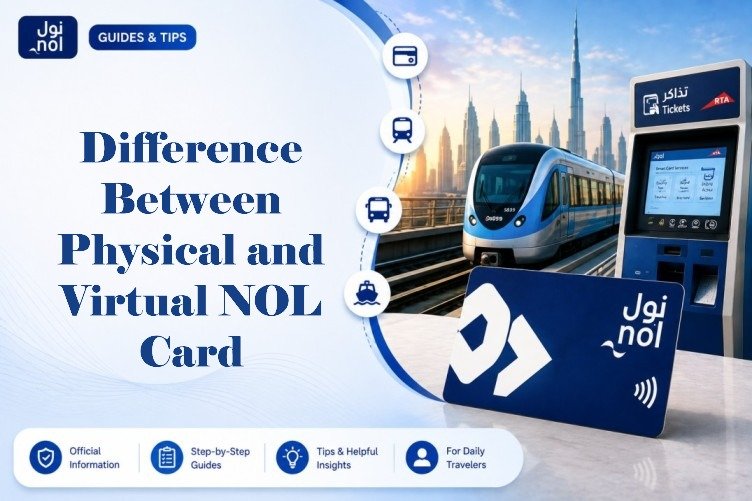
If you commute in Dubai, you have probably used a NOL Card to pay for the metro, bus, tram, or even parking. What many riders don’t realize is that this card now comes in two forms: a traditional plastic card and a digital version stored on a smartphone. Understanding how these two options differ can help you choose the one that fits your daily routine, whether you value convenience, backup security, or simple habit.
This article breaks down what separates a physical NOL card from its virtual counterpart, covering how each works, who can use them, and which situations favor one over the other.
What Is a NOL Card?
A NOL card is a reloadable smart card issued by Dubai’s Roads and Transport Authority (RTA) that lets riders pay fares across the city’s public transport network with a single tap. It works on the metro, public buses, the tram, and marine transport, and it can also be used for parking fees and payments at select retail outlets.
The card comes in several tiers, including Red, Silver, Gold, Blue, and Personal cards, each designed for different rider needs. Regardless of the tier, the underlying technology stays the same: a prepaid balance that gets deducted automatically when the card is tapped at a reader.
What Is a Physical NOL Card?
The physical version is the original format most Dubai commuters are familiar with. It’s a small plastic card, similar to a bank card, that riders tap at station gates or onboard readers to validate their journey.
Types of Physical Cards
Physical cards are sold at metro stations, RTA service centers, and authorized retail points. The Silver and Gold cards can later be converted into a digital format, while Red and Blue cards generally remain physical-only options depending on how they were issued.
How to Get One
Getting a physical card is straightforward: purchase it at a station kiosk or vending machine, pay a small issuance fee, and load it with credit. From that point, topping up can be done at machines, through the RTA app, the RTA website, or the S’hail app.
What Is a Virtual NOL Card?
A virtual card is a digital version of the same fare card, stored directly on a compatible smartphone or smartwatch instead of a physical piece of plastic. Riders simply tap their phone at the entry gate instead of a card, using near-field communication (NFC) technology to complete the transaction.
Supported Devices
Digital NOL cards are currently available on select Samsung and Huawei devices. Samsung users can digitise their card through Samsung Wallet, while Huawei users can do the same through Huawei Wallet or a compatible Huawei Watch. Apple has not yet enabled support for digital cards on iPhones, so Apple Wallet users still rely on the physical option.
How to Digitise Your Card
Only Silver and Gold cards are eligible for digitisation. The process involves opening the relevant wallet app, selecting the option to digitise an existing card, and holding the physical card against the back of the phone so its balance and travel passes transfer over NFC. Once the transfer completes, the physical card becomes invalid and can no longer be used.
Key Differences Between Physical and Virtual Cards
Convenience
A virtual card removes the need to carry a separate card altogether, since your phone becomes the payment method. A physical card, by contrast, must be carried and kept accessible every time you travel, which means it’s easier to forget at home.
Device Compatibility
Physical cards work for everyone, regardless of what phone they own. Digital versions are currently limited to specific Samsung and Huawei models, so not every commuter can switch to the digital option yet.
Card Replacement and Loss
If a physical card is lost, the balance may be recoverable only if the card was registered, and a replacement card must be purchased. A digital card, being tied to a smartphone, avoids the risk of losing a small physical object, though it introduces a dependency on the phone’s battery and functionality.
Top-Up and Balance Management
Both formats can be topped up through the RTA app, the RTA website, or the S’hail app. The main difference is that a digital card’s balance is managed directly within the connected wallet app on the phone, while a physical card can also be reloaded at station machines and retail counters.
Which One Should You Choose?
If you already own a supported Samsung or Huawei device and want one less item to carry, switching to a digital card makes daily commuting simpler. If your phone isn’t compatible, or you prefer having a dedicated card that doesn’t depend on battery life, sticking with the physical version remains a reliable choice. Many riders also keep a physical card as a backup even after digitising, in case their phone runs out of charge.
Frequently Asked Questions
Can I switch back to a physical card after digitising it? Once a card is digitised, the physical version becomes invalid. Riders who want a physical card again typically need to purchase a new one.
Do I need an internet connection to use a digital card? No constant internet connection is required to tap and pay, but NFC must be enabled on the phone, and the wallet app should be kept updated.
Which card types can be converted to digital? Currently, only Silver and Gold cards are eligible for digitisation.
Is a digital card available for iPhone users? Not yet. Apple Wallet does not currently support digital cards, though RTA has indicated it is working on expanding compatibility.
Does a digital card cost more to set up? Digitising an existing card does not require purchasing a new card, since the balance transfers from the physical version during setup.
Can I use a digital card for parking and retail payments? Yes, digital cards support the same range of services as physical cards, including parking fees and payments at select retail outlets.
What happens to my travel pass when I digitise my card? Any active travel pass on the physical card transfers to the digital version during the digitisation process.
Are digital cards safer than physical cards? Digital cards reduce the risk of losing a small plastic card, but they depend on the phone remaining charged and functional, which is a different kind of risk to manage.
Conclusion
Both the physical and virtual NOL card serve the same core purpose: fast, tap-and-go payment across Dubai’s public transport network. The physical card remains the universal option that works for every rider, while the digital card offers added convenience for those with supported Samsung or Huawei devices. Choosing between them comes down to personal preference, phone compatibility, and how much you value not carrying an extra card in your wallet.