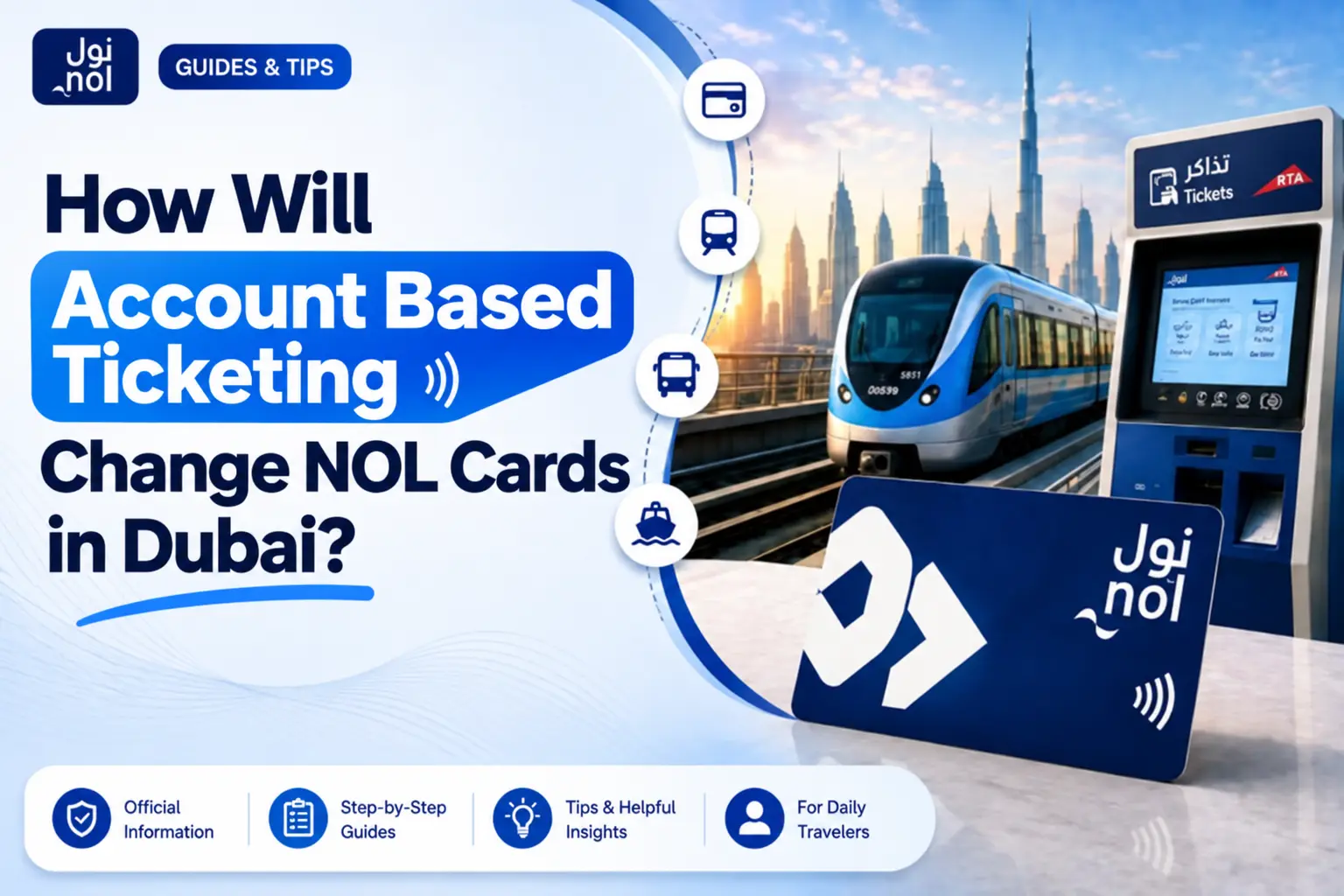
Dubai’s nol card has worked the same basic way since 2009: top up the card, tap it, and the balance lives on the card itself. Account based ticketing changes that structure, and commuters want to know exactly what will look and feel different once it’s fully in place.
This article breaks down what account based ticketing actually changes about nol cards, what stays the same, and how the transition is being rolled out.
What Is Account Based Ticketing?
This ticketing model is a fare payment structure where balance, travel history, and payment details are stored in a central digital account rather than on a physical card. The card becomes a way to access the account, instead of being the account itself.
RTA is applying this model to nol as part of its Digital Strategy Roadmap 2023-2030, moving the system away from its original card based ticketing (CBT) design.
How This Differs From the Current NOL System
Under the current setup, a nol card’s balance and history exist only on the card. If the card is lost, damaged, or stolen, recovering that balance is often difficult or impossible.
This shift removes that single point of failure by keeping the record centrally. The card still gets tapped at gates, but the actual balance check happens against the linked account.
Key Changes Account Based Ticketing Brings to NOL Cards
This upgrade introduces several practical changes for everyday nol users.
Balances Move From the Card to the Account
Once a nol card is linked to a digital account, the balance is tracked centrally instead of stored on the card’s chip. This is the core shift that account based ticketing is built around.
Lost or Damaged Cards Become Recoverable
Because the balance sits with the account, a lost or damaged nol card can be suspended and its balance retrieved. Under the old card based model, this kind of recovery generally wasn’t possible.
Multiple Cards Can Link to One Account
Account based ticketing allows several nol cards, including those belonging to family members, to be linked under a single account. This makes it easier to manage top ups and monitor usage across a household.
New Payment Methods Become Available
As part of the same upgrade, commuters will gain the option to pay using bank cards, digital wallets, and QR codes, alongside nol cards. These options only work because the shared account structure gives every payment method a common balance to draw from.
Automatic Top Ups Become Possible
With an account based structure, users can link a bank account and enable automatic balance top ups, removing the need to manually recharge a card at a kiosk or machine.
Transaction History Becomes Visible
This new account system gives users access to daily transaction statements, travel history, and fare breakdowns through their linked account, rather than relying on card readers or in person balance checks.
What Stays the Same
Not everything changes with account based ticketing. Several parts of the nol experience remain familiar.
- Nol cards continue to be issued and accepted throughout the rollout.
- Tapping a card at a gate or validator still works the same way physically.
- Existing card balances are not lost or reset when a card is linked to an account.
- Fare pricing structures are not part of this upgrade itself.
How the Rollout Is Being Phased
RTA is introducing account based ticketing in three phases rather than switching everything at once.
- Phase 1 upgrades the central system to support digital account creation and card linking.
- Phase 2 introduces a new generation of nol cards built to align with international banking-card standards.
- Phase 3 adds alternative payment methods, including bank cards, digital wallets, and QR code tickets.
By mid 2026, RTA reported the project had reached 72% completion, with full deployment of account based ticketing targeted for the end of the first quarter of 2027.
Who Benefits Most From Account Based Ticketing
Regular Commuters
Daily nol users gain automatic top ups, visible transaction history, and protection against losing a card’s balance if the card is misplaced.
Families
Parents can link children’s nol cards to their own account, making it simpler to manage multiple cards without tracking separate balances.
Tourists and Occasional Riders
Visitors can still use a standalone nol card without creating an account, while those who prefer using a bank card or digital wallet will have that option once Phase 3 is live.
Frequently Asked Questions
What does account based ticketing mean for my current nol card?
Your existing nol card continues to work. This model links it to a digital account so its balance and history are recorded centrally instead of on the card itself.
Will I lose my balance when nol cards move to account based ticketing?
No. Existing balances carry over when a card is linked to an account. This system is designed to protect balances, not reset them.
Do I need a smartphone to use account based ticketing?
Managing an account typically involves a digital channel such as an app or website, but tapping a linked nol card at a gate does not require a smartphone.
Can I still use a nol card without creating a digital account?
Yes. Nol cards remain usable during the rollout even without linking them to an account, though account features such as automatic top ups won’t be available.
How does the new system help with a lost nol card?
Because the balance is stored with the account rather than the card, a lost card can be suspended and its balance recovered instead of being permanently lost.
When will this new ticketing system be fully available across Dubai’s transport network?
RTA has targeted full rollout by the end of the first quarter of 2027, following phased progress that reached 72% completion by mid 2026.
Does this upgrade change how much a fare costs?
No. This upgrade changes how balances and payments are managed, not the underlying fare pricing structure.
Conclusion
This shift moves the core of Dubai’s nol system from the card to a linked digital account, making lost card recovery, automatic top ups, and multi card family management possible for the first time. Nol cards themselves aren’t disappearing, and the phased rollout means most of these changes will arrive gradually rather than all at once, with full deployment expected by early 2027.